
Bringing AI agents into a company isn’t just about architecture or governance, it’s largely a design challenge.
Last week I was up late fixing bugs in one of my own Claude AI agents. I’m the CEO of Mindset, and I probably had no business coding agents at 9pm, but I wanted it to work. And when it finally did, the agent gathered data from my ERP, my CRM, project plans, communications, and spawned research far beyond what I could have ever accomplished before. It uncovered insights I had never seen, and we were able to pinpoint the right person and the right solution and tackle it immediately. And that took a real human phone call at that point (fine, a Slack message).
I’ve spent the last year building agents like this inside my own company. The challenge for me, though, hasn’t been the technology, which is now very good (and I find this quite fun). The models are good, getting better, the plumbing is just plumbing. The hard part is very human: figuring out how a person and agents work together without it turning into chaos or a threat! (sorry again to my team at Mindset who has to put up with my constant experiments!)
That’s the question I don’t think enough people are asking.
I really enjoyed Marc Kermisch’s article recently talking about the layers of AI and a race to governance and control planes. I agree these are very important, but the comments on his article point to a deeper issue. Who do your agents report to? And the platform isn’t the answer, it’s still a person.
An agent must report to the manager of the job it does. Same as an employee. And that’s a design decision, which is what Mindset and the AppHaus have always cared about.
The growing org chart
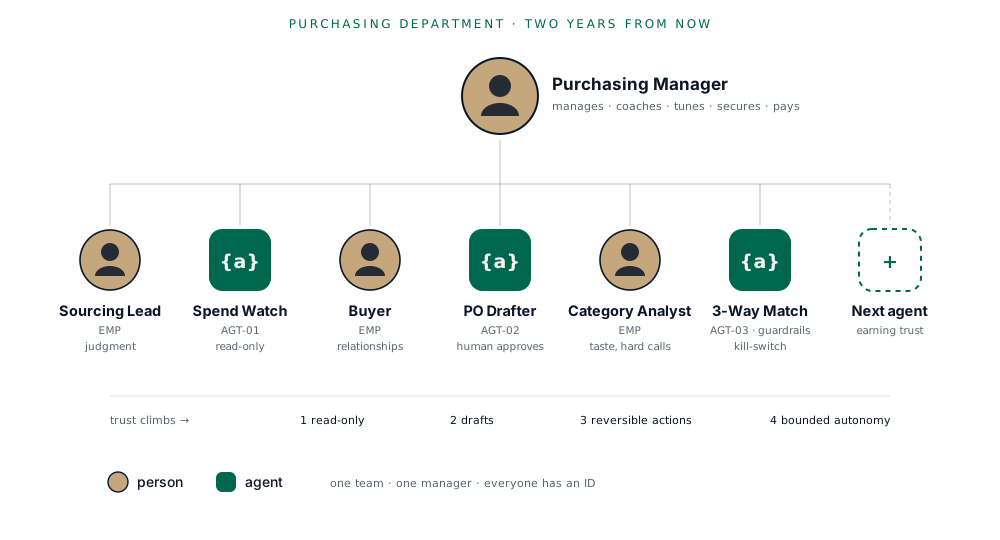
Two years from now, I can imagine an org chart where every functional manager still has people, but they also have agents in the org chart, with IDs, sitting next to them. Doing parts of the tasks that agents are good at, with the humans doing the human part. The manager’s job is still to manage them, tune, secure, pay, coach, and these agents cost real money!
The people move up the chain a bit, but the agents help take repetitive tasks, summary work. Humans take jobs with taste, judgement, relationships. This should make us all better.
But this hand-off must be designed. What does the manager see? What do they approve? What work is a real challenge? And with AI changing, how does this dynamic change every quarter?
Through all of this, we are basically redesigning how people interact with machines. When is a prompt the right tool? When is an agent? When should you use an app with a screen and a button, and oh no, not a spreadsheet!? They will never be defeated by AI. The answer is in the middle, and each person needs their patterns redesigned and continuously optimized.
Start with design. The same old design thinking you have always done.
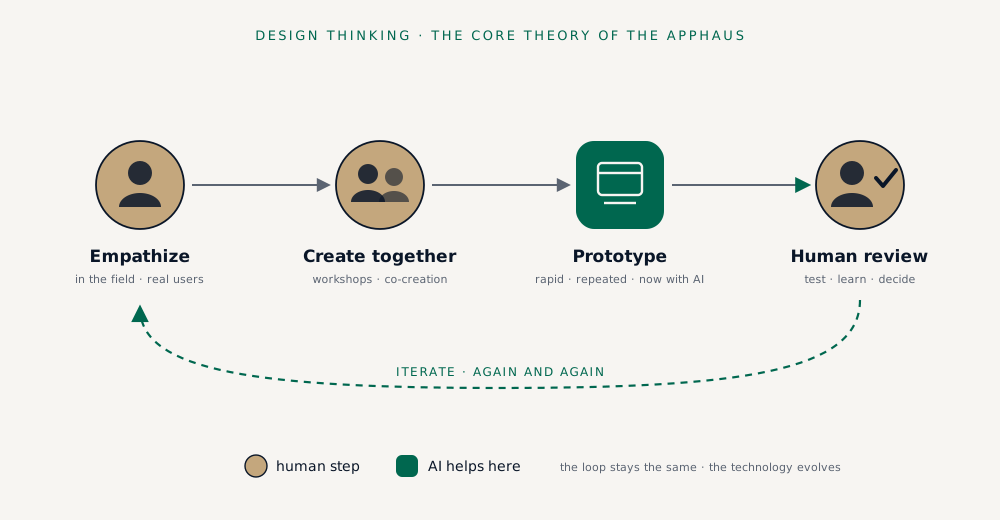
For those not familiar with design thinking, it’s the core theory behind the AppHaus. See the diagram below. In short, it’s about empathy, spending time directly in the field with real users, being creative together, iteration, rapid and repeated prototyping with human review. The system is the same with AI, the technology just evolves. High-resolution prototypes may now be created with AI instead of manually in prototyping software like Figma.
So yes, don’t let agents loose in the wild, that is what everyone is afraid of. Don’t give them the keys and run away. Iteratively give them tasks, learn, redesign, learn. This is also the same iterative development. Let’s take a purchasing manager in SAP as an example:
- First, the agent reads spend, flags duplicate vendors and price gaps. Read only, no risk. But it can show you what it’s doing and build trust.
- It starts drafting purchase orders and suggesting reorders. The manager reads and clicks and decides. Work with that for a while.
- Make small reversible actions. Create POs under a certain amount or do a 3-way match. Release orders within policy. Of course have a kill-switch, audit trail, and the manager still owns exceptions.
- Next, for narrow categories, act within limits and the manager reviews reports and checks in regularly.
You onboard like a new hire on probation, giving it more trust as it grows.
Some people call this human in the loop. It’s an important tactic in the short run, and it may very well be a long-term solution. When we stick with our manager and managee metaphor, though, we don’t expect a manager to be in the loop for every task an employee executes. That wouldn’t be efficient, and at some point they would stop adding value. I would prefer to evolve to the manager auditing, with alternative validation mechanisms, so we can scale.
Why this is now possible
Two things changed. Agents can now truly reach into your system data instead of forcing you into one platform. And the thing that actually makes agents good is domain expertise, not tech skill. Check out this study from Anthropic, where they analyzed hundreds of thousands of sessions and found people still make most of the plan while the agent executes. The SAP data, though, in the purchasing manager’s head is what is important. Knowing which vendor may slip the deadline. The agent can then provide 24×7 scale.
So you don’t need to migrate your entire company into some external brain. You have the brains, you can just build well designed agents one at a time, with the right people monitoring.
Let’s be honest, we’re in the beginning stages of this
At Mindset we’re building it on ourselves right now. Agents for triage on inbound leads, account data cleaning, agents that are toolchains for our consultants that arm them with 10+ years of projects and insights and SAP knowledge. We’re figuring it out. But that’s the point, you don’t just buy something and forget it. You design, adopt, grow, iterate. Like any software project.
That’s also the work I want to do for the companies we serve, changing the experience with SAP. Now it’s a remarkably new experience, but the same AppHaus process. Design, understanding, empathy, context, imagination, iteration, building that together.
