
Some years are made up of events. Others are made up of moments—inflection points where subtle yet prominent shifts occur beneath the surface, like tectonic plates. For Mindset, 2025 was the latter. This year, AI stopped living on the edges of SAP conversations and took center stage. It wasn’t a buzzword anymore, nor as an optimistic ‘future state’, but as a practical, architectural, human-centered question we heard from customers so many times:
“How should we actually use AI inside SAP, and how do we do it without breaking our business processes and the trust of our people?”
We didn’t approach the year with a predetermined answer. Instead, the year unfolded through five key moments, each revealing a different layer of readiness, concern, and possibility inside the SAP ecosystem.
Looking back, these moments make up for Mindset’s journey. A story that brought us from curiosity to clarity, from theory to practice, and from cautious optimism to confident experimentation.
Moment #1: February — The Door-Opening Roundtable
Curiosity Before Conviction
In February, we hosted an Agentic AI Roundtable with our SAP partners Dr. Peter Kaiser, Senior Director and Enterprise Architect at SAP AppHaus, and Sankara Narayanan Raja, Senior Business Process Consultant at SAP Adoption Services Center. The conversations were filled with curiosity and fascination. With 211 registrants, participants asked fundamental—and sometimes provocative—questions to make sense of something that clearly mattered:
- “What exactly is an agent?”
- “Is Joule real or still marketing?”
- “Is this the next Fiori moment… or the next RPA moment?”
There was no cynicism, only that very specific blend of excitement and caution you sense when a topic is both new and consequential.
When the Abstract Became Concrete
When Dr. Kaiser showed the early SAP Agent Builder, the energy shifted (see Image 1). The audience leaned in, not because the tool was flashy, but because it made the abstract tangible. Folks could see how a system might reason, reflect, call tools, adjust its plan, and still operate inside SAP’s data world.
One participant asked a practical question: while the demo made the model’s reasoning visible, would it also show which agents were involved in executing a task? The answer was yes. When using the Agent-to-Agent option, that orchestration appears in the logic view, showing not just the outcome, but how multiple agents worked together to reach it.

Practicality and Limits in Practice
Another participant asked where agents aren’t the right answer. Ethan Jewett, Mindset’s Senior Director for DevOps, acknowledged that while agents are powerful, they’re not suited for every scenario. Complex, end-to-end processes like full supply chain planning, for example, still require broader systems and orchestration beyond what agents can reliably manage today. This is where the AppHaus approach of human-centered design helps teams assess when AI agents make sense, and when other patterns are more appropriate (see Image 2).

What Do We Really Mean by ‘Agents’?
The discussion also turned reflective. One participant observed that what we call an ‘agent’ looks very much like a task—sometimes with multiple sub-tasks—and wondered whether the industry was simply relabeling familiar execution patterns. Sankara acknowledged the overlap, but pointed out that the distinction lies in autonomy. In the SAP Business AI context, agents execute tasks and sub-tasks with reasoning and decision-making, rather than following a strictly predefined sequence. The shift in language reflects a move from traditional task execution toward AI-driven systems that can adapt how work gets done.
The roundtable didn’t answer every question, nor was it meant to. Instead, it surfaced a shared readiness to move beyond theory and into design. If February opened the door to agentic thinking, the next step was to actually begin shaping what agentic AI could look like in practice.
Moment #2: April — Designing AI Agents In Silicon Valley
A fun-filled collaboration between Mindset and SAP
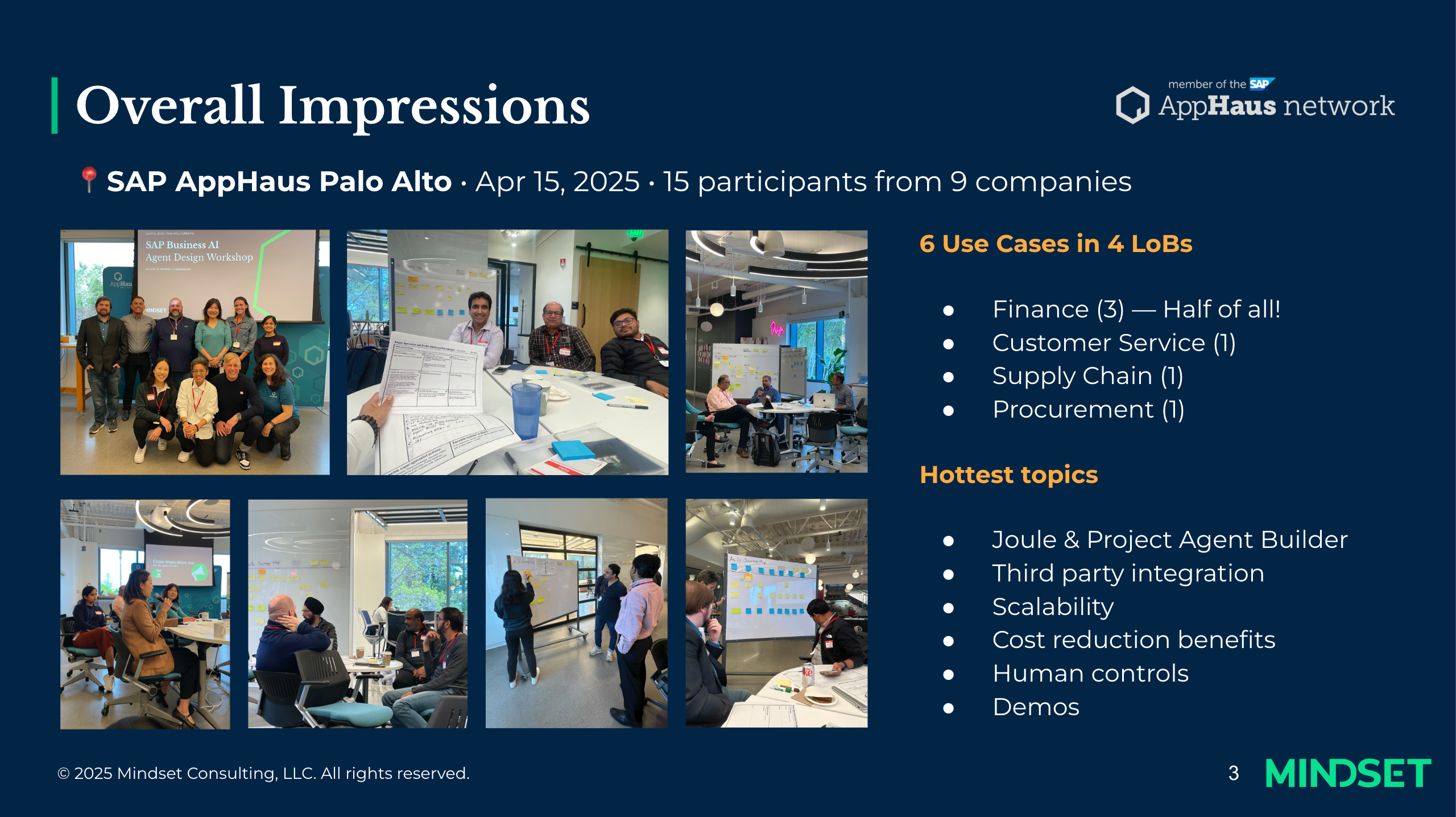
Spring season took us to SAP AppHaus in Palo Alto. We’re grateful to have teamed up with our SAP AppHaus friends Tina Tuan, Sr. Director of Ecosystem Program, Sally Lawler Kennedy, Sr. Director Innovation & Customer Experience, and Carlos Estala Velasco, Co-Lead SAP AppHaus Network & Enterprise Architect, as well as Tripp Morson, Solution Advisor Expert at SAP BTP CoE.
Front-runners tackling pressing issues & opportunities
Our Agentic AI Design Workshop brought together 15 participants from nine organizations with the intention of moving agentic AI from concept to concrete exploration (see Image 3). Six use cases emerged across four lines of business, with finance leading the discussion, highlighting where pressure meets opportunity most clearly today. What stood out was not just the interest in Joule and agent builders, but the collective focus on scalability, cost impact, third-party integration, and the role of human controls. This indicated that teams were beginning to think about how agentic AI would actually work in production, particularly within SAP environments.

AI Agent Use Case Summaries
During a warm-up on how much autonomy AI solutions should have, the room leaned toward AI as a trusted assistant, even as some began to question where the boundaries of autonomy might eventually shift (see Image 4). This highlighted the need for thoughtful agent design, as participants appeared comfortable increasing AI responsibility, but not relinquishing control completely. To that end, the participants prototyped agent solutions across key business areas, as summarized below:
| LoB | Agent Role | Main Objective | Key Tasks |
|---|---|---|---|
| Procurement | Procurement Super Specialist | Streamline the demand-to-procure process so that all products are bought at an optimal price | Review demand and market data, execute the RFP lifecycle, negotiate, and perform calculations for savings |
| Supply Chain | Inventory Management Assistant | To assist in filling orders and inventory accuracy | Identify order requests and cross-check with inventory, report consumed inventory, and notify personnel of discrepancies |
| Customer Experience | State License Verification Agent | Verify customer State Licenses and ensure orders are not stuck due to missing or expired licenses in SAP Global Trade Services (GTS) | Verify licenses in GTS, prompt medical compliance systems for missing/expired licenses, update GTS, and notify the customer |
| Finance (3 scenarios) | Cash Management Agent | Optimize cash management | Data collection, analyze market/loan rates, and provide prioritized investment option recommendations |
| P.O. Accrual Specialist | Automate the Purchase Order (PO) accrual process | Gather open PO and inflight invoice info, calculate accrual amounts, and post accounting entries in SAP | |
| Financial Analyst | Deliver an actionable report to Senior Management on discovered discrepancies and variances | Data collection, data cleansing, analysis, and report compilation |
Distinct collaborative, Silicon Valley energy
Overall, participants valued the in-person format, the structured approach to exploring use cases, and the opportunity to collaborate across industries. Many left with a clearer understanding of agentic AI and how to think about adopting it in practice. The full workshop report can be accessed here, with more details on the use cases and workshop content.
On a personal note, the energy in Silicon Valley felt distinct from other AI workshops we ran the year before—more open, more experimental, and more willing to engage with uncertainty. While April was about hands-on exploration, that momentum carried forward, setting the stage for deeper collaboration and stronger partnerships in the months that followed.
Moment #3: May — Partnership with Nova Intelligence
By May, the conversations around agentic AI were shifting again. What began earlier in the year as curiosity and hands-on exploration was tied back to questions of execution:
- How SAP customers can modernize responsibly
- How to move faster without compromising Clean Core principles
- How to turn promising ideas into something tangible
It was in this context that Mindset formalized a strategic partnership with Nova Intelligence, a Silicon Valley-based firm focused on multi-agent AI solutions for SAP Clean Core modernization. What made the partnership resonate was the complementarity—Nova brought deep GenAI intuitiveness and multi-model intelligence, while Mindset brought SAP architecture expertise, clean-core discipline, and a human-centered approach to innovation. Collectively, the focus was not just on building AI-driven solutions, but on doing so thoughtfully by:
- Developing Clean Core–aligned capabilities
- Designing experiences people can trust
- Delivering joint proof-of-concepts that show real, near-term value for SAP customers
In essence, May marked a reinforcing moment rather than a pivot. The partnership strengthened the ecosystem around us, ensuring that the questions and use cases surfaced earlier in the year could be carried forward with greater depth and executional rigor. That foundation would become especially important as the next set of conversations brought a broader mix of perspectives, and a reflection of where and how the market has evolved.
Moment #4: August — Revisiting AI Agents in our Roundtable
Unpacking questions among SAP customers
By August, we were back in roundtable mode, this time with SAP’s Doug Freud, VP Data Science & Data Management for SAP BTP, and Ian McCallum, AI Strategy and Solution Advisor. The session felt more like a listening lab as we discussed the sentiments around how AI is being adopted and what roadblocks SAP customers are experiencing (see Image 5).

We gathered 124 pre-survey responses, and reading through them felt like hearing the SAP market narrate its inner monologue:
- “How does Agentic AI work in SAP?”
- “We need ROI, not hypotheticals.”
- “Our data isn’t clean enough.”
- “We don’t know where to begin.”
- “We’re excited… but nervous.”
Showing the big picture with Agentic AI and SAP
As part of our discussion, Doug and Ian helped ground the roundtable by tracing the evolution from early chat-based experimentation to agent-driven systems designed for enterprise-scale transformation. They also walked through how SAP is positioning AI for the enterprise, moving toward an AI-first, suite-first model where Joule orchestrates AI agents across business processes built on SAP Applications and data from SAP Business Data Cloud (BDC). Through semantically aligned data in BDC, domain-specific agents can operate contextually across SAP and non-SAP environments, enabling end-to-end enterprise automation. We also discussed how agents are shifting from predefined workflows toward more adaptive, collaborative models, and what this means architecturally including Joule for SAP ECC customers, as well as with the introduction of Model Context Protocol (MCP) as an extension to agent-to-agent patterns, supporting greater interoperability across SAP and non-SAP ecosystems (see Image 6).

Real demos and SAP capabilities with AI Agents
To make the theoretical discussions concrete, we showed demos of how agentic concepts translate into working solutions (see Image 7). Through demos of a Maintenance Agent and a Logistics Agent, participants saw how agents can be composed from discrete skills, connected to SAP data and processes, and guided by clear instructions and guardrails. The accompanying architecture views illustrate how Joule Studio and the Project Agent Builder sit within SAP BTP, enabling teams to design, deploy, and extend agents that integrate securely with SAP and third-party systems. Together, these examples helped bridge the gap between conceptual agent frameworks and the practical mechanics of building, orchestrating, and governing agents in an enterprise SAP landscape.

Overall, we observed three themes throughout the conversation:
- The desire is high
- The confidence is low
- The gap is bridgeable — with clarity, not hype
In many ways, August was the moment the ecosystem told us what it really needs: guidance, governance, groundedness, and a bit of hand-holding through the haze. For us, we sought to deepen our understanding by getting hands-on with SAP Joule Studio.
Moment #5: September — Inside SAP Joule Studio Beta Program
And then came September, where Mindset was selected by SAP as one of the global partners to participate in the Joule Studio Agentic Beta Program. We were thrilled with the opportunity, as it gave us early, hands-on access to SAP’s next-generation environment for designing, orchestrating, and governing AI agents.
Anchoring in real SAP customer challenges
We evaluated several real customer scenarios before landing on a use case that is essentially an evolution of our customer service assistant powered by Gen AI, but this time with Agentic AI. Using SAP AppHaus innovation toolkit, we outlined the business challenge with an AI use case brief (see Image 8), which helped us stay focused on the problem to solve:
- Customer service teams handle 10,000+ inquiries daily across email, chat, and voice
- Data is fragmented—orders in ERP, account history in CRM, knowledge in document repositories—forcing representatives to manually assemble context
- Average handle time is at 12 minutes, with inconsistent resolutions and high Tier 1 churn

Storyboard to visualize the solution
Image 9 illustrates the proposed solution: a conversational copilot built on SAP Joule, leveraging SAP Build and backend data from S/4HANA. The agent interprets natural language, aggregates information across systems via unified APIs, summarizes customer context, and executes predefined tasks such as checking order status and generating PDFs. While seemingly basic, document generation remains a persistent pain point for SAP customers due to the effort required to piece together information across systems.

The anticipated impact included a 70% reduction in handle time, a 30% shift of Tier 1 cases to AI, a 15% increase in customer satisfaction score (CSAT), and a reduced training ramp from four weeks to one.
Prototyping Joule AI Agents with SAP Build
Our weekly Studio Jam sessions brought together a cross-functional Mindset team, including our Principal Designer, Sab Cheung; Lead Engineer, Akhil Das; and myself as Innovation Lead, alongside the SAP product team. We were also supported by a trusted internal sounding board spanning engineering, product, solution architecture, and account leadership, helping us stay grounded in real customer needs. None of this experimentation would have been possible without the vision and encouragement of our CEO, Gavin Quinn. It truly took an interdisciplinary team to bring this to life.
Image 10 shows our hands-on experience building agents in Joule Studio within SAP Build. We defined agent expertise, shaped instructions, connected skills to real SAP APIs, and tested agent behavior against our S/4HANA landscape. What stood out was how tangible the process felt—agents weren’t merely configured, but designed with context, guardrails, and purpose. There were many moments when we stumbled over technical challenges but what helped in problem solving was going back to our intention for the end-user, reinforcing that building agentic AI in SAP is as much about thoughtful design as it is about technical setup.

Seeing our Joule prototype come to life
The resulting prototype shows how agentic AI can deliver immediate, user-facing value (see Image 11). Using natural language prompts, Joule retrieved live sales order data from S/4HANA, surfaced order details, and generated a downloadable PDF. The continuity, from conversational inquiry to structured output, highlighted how agents can bridge enterprise data and user intent without pushing users back into transaction-heavy workflows.

Designed with the Customer Service Representative in mind, the solution enables users to:
- Access real-time customer context in one place
- Reduce navigation across SAP transactions
- Resolve common inquiries in seconds rather than minutes, especially for document and invoice retrieval
We’re thankful for the opportunity to participate in the SAP Joule Studio Agentic Beta Program, which gave Mindset more hands-on experience designing, building, and governing AI agents against real S/4HANA customer scenarios. More than the technology itself, the experience emphasized that successful agentic AI in SAP depends on thoughtful design, clean integration, and a deep understanding of how users actually work, strengthening our confidence in helping customers build agents with Joule.
Looking Back, and Looking Forward
Upon reflecting, a narrative unfolded through these five key moments:
- February was about curiosity, with permission to ask foundational questions
- April brought purpose, as teams began shaping agentic ideas through human-centered design
- May added capability, strengthening our ability to execute through partnership
- August centered around honesty, reflecting the market’s excitement alongside its uncertainty
- September gave us proof, showing what agentic AI can look like when designed, built, and governed with real users and SAP systems
Collectively, these moments point to a future where Agentic AI in SAP is not about replacing people or automating for automation’s sake, but about augmenting work in ways that are contextual and intentional. As we look ahead, our focus remains the same: helping SAP customers move forward with clarity, care, and confidence by designing AI that works with people, not around them.
If you’re exploring what AI agents could mean for your organization, we’d love to learn from your perspective and explore the journey together.
Interested in learning more?
Visit Mindset’s Linkedin
Visit Mindset’s Blog Library
Visit Mindset’s YouTube Page