
By Ethan Jewett and Robb Neuenschwander
The customers we serve at Mindset are often large, complex companies with a variety of enterprise tools in their landscape. A question we frequently get from these customers is some variation of: “We already own MuleSoft (or Boomi). Integration Suite makes sense when SAP is on one end of the interface. Why would we put anything else on it?”
It’s a fair question. Often, these clients see Integration Suite as an SAP adapter with a variety of features that also align to other enterprise integration platforms. Thus, once SAP is taken from the scenario, it loses its value. What people don’t seem to realize is that when Integration Suite loses its clear SAP connectivity advantage, it’s still an excellent and very competitively priced integration platform. What’s left is a pretty even match on capability, and Integration Suite usually comes out ahead on cost. This document explores that comparison as best we can by deeply researching publicly available information.
For the purpose of this text, I’m going to stick to large SAP customers who already run more than one integration platform, because they’re the ones we are mostly speaking with. I’m also going to stick to published list prices and vendor documentation, with links. As you likely know, each implementation involves a contract and a negotiation, so please read the numbers as a rough shape for comparison and not a quote.
Also, we must disclose up front that we’re an SAP partner, and Integration Suite is at the heart of most of our integration work. We also have people working in MuleSoft at client sites, and nothing below is meant as a knock on MuleSoft or Boomi. They are very good platforms and many customers are very happy using them. Our focus here is to help customers understand some of the tradeoffs and comparisons as best as possible.
What “non-SAP” means
“Non-SAP integration” can actually refer to a variety of situations. In practice, we usually see it meaning an integration between SAP and a non-SAP system (like a bank or a trading partner), or an integration between two non-SAP systems (like Salesforce to Workday).
I’ll cover both scenarios. Keep the distinction in mind, because the cost picture changes between them.
Many, many Integration Suite customers already use it well beyond SAP. IDC recently interviewed eight of them for a study SAP paid for (IDC), so take it with a grain of salt. On average, 64% of the applications they connect through Integration Suite aren’t SAP, and 82% of their integrations touch at least one non-SAP application. At the median, SAP-to-non-SAP integrations (70) outnumber both those with no SAP on either end (20) and SAP-to-SAP (10).
Capability is an even match
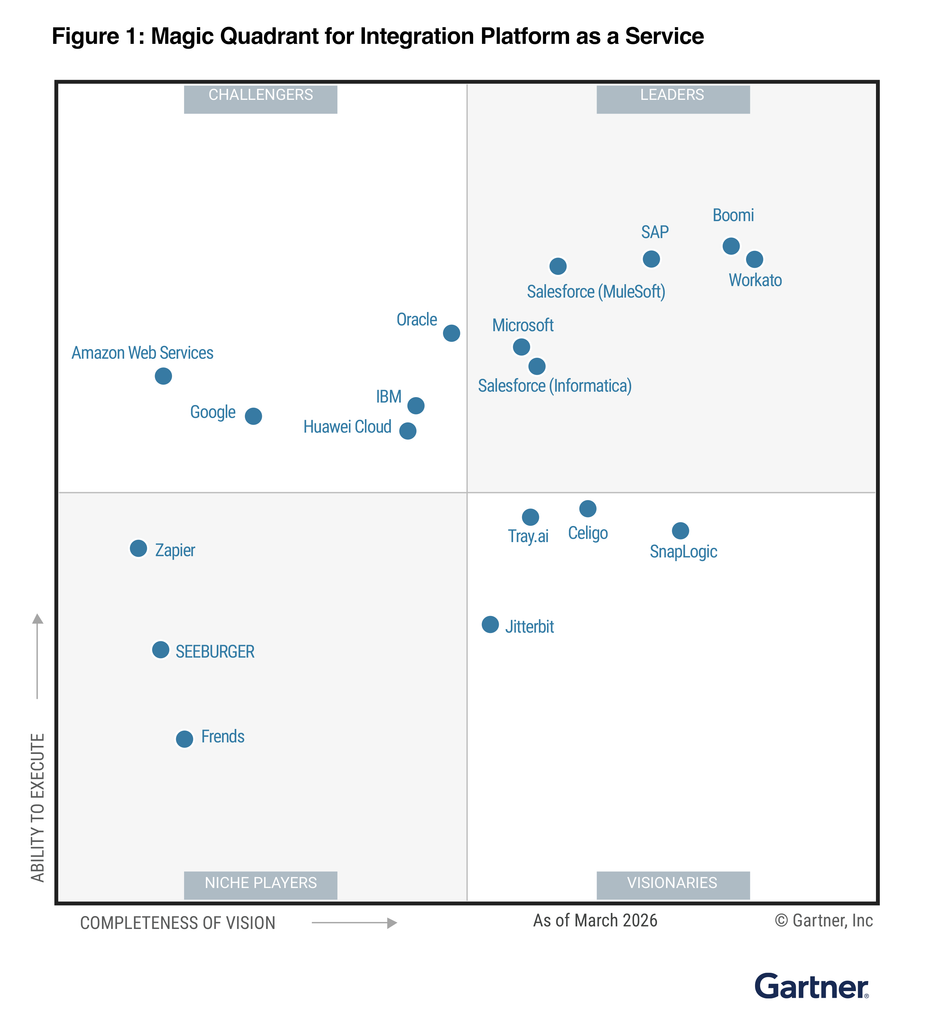
For mainstream work (using patterns like REST, SOAP, SFTP, JDBC, queues, the big SaaS applications), I don’t think any of the three platforms has a meaningful lead. All three are Leaders in Gartner’s 2026 Magic Quadrant for iPaaS (SAP, MuleSoft, Boomi), which mostly tells you the analysts seem to agree that they all do the job pretty well.
The IDC customers add one more important data point. They said building an integration took 41% less time than what they had before, and the biggest drop (48%) came on integrations with no SAP on either end. What were they migrating from? It was largely older SAP middleware, other ESBs, or custom code. It wasn’t generally MuleSoft or Boomi. It does suggest, however, that Integration Suite doesn’t lose its value once SAP drops out.
Each one does have a lead somewhere.
MuleSoft leads in governing other vendors’ API gateways and also orchestrating LLM traffic. Its Omni Gateway can scan policies across Kong, AWS, Azure API Management, and Apigee, with its enforcement capabilities delivered on Kong first (MuleSoft). Its Model Proxy for LLM traffic shipped in March (release notes). SAP’s competing service, AI Gateway, is planned for Q4 2026 (Sapphire guide). If you need either of those things today, that matters.
Boomi leads on its volume of available connectors (“1,000+ prebuilt connectors,” by its own count) and by boasting the lightest self-hosted runtime. Boomi runs as a Java process on a VM with as little as 2 GB of RAM (Boomi), or from images on Docker Hub (Boomi). Integration Suite’s competing offering, Edge Integration Cell, requires a Kubernetes cluster (SAP Help).
As you might expect, Integration Suite leads on, the SAP end. But it also has more strength in other areas than people tend to give it credit for. API management is provided in the platform, including a developer hub with self-registration (SAP Help). The MCP Gateway, which puts SAP APIs, non-SAP APIs and integration flows behind one governed entry point for agents, has recently been released in the Enhanced and Premium editions (SAP). These are the features that companies are looking for in an integration platform as they build out AI projects. In the IDC survey, the top two roles identified were “secure, compliant dataflows” and “real-time exchange and orchestration” (IDC). Integration Suite’s Standard offering includes Event Mesh for smaller event volumes (SAP Architecture Center), and Advanced Event Mesh handles the big installations.
MuleSoft also leads on the out-of-the-box developer feature list. I’ll come back to that, because I think it’s the most interesting difference of all.
What each vendor charges for
Pricing is where we see the biggest difference across these vendors, so I want to spend some time focusing on real numbers here. None of them make it easy to do this comparison. Even the IDC paper (again, the one that SAP paid for) says “SAP’s pricing and modular approach can be complex, especially for organizations with mixed SAP/non-SAP environments.” That said, SAP’s list pricing is the only pricing of the three that is actually published. This establishes a ceiling for pricing that customers should be able to rely on.
Integration Suite is licensed on 2 different metrics: tenants and messages” (SAP). A Standard tenant lists at $5,361 a month with 10,000 messages included (sap.com). Enhanced Edition comes in at $7,685 per month with 500,000 messages included. After that you buy blocks of 10,000 messages, and the price per block falls from €6.08 to €0.89 as your volume grows (Discovery Center). There’s no charge per integration flow and none per endpoint.
MuleSoft charges for both flows and messages, and it bills every environment. The documentation on this is pretty specific: “You consume credits at the same rate across all environments, including production, pre-production, sandbox, and design” (MuleSoft). MuleSoft’s usage reports also multiply flow counts by workers or replicas (MuleSoft). Thus an application on two replicas to account for high availability likely counts twice. SAP connectivity for MuleSoft is a “Premium” connector, and “Premium Anypoint Connectors must be licensed for each deployment environment” (MuleSoft).
Boomi is in transition. Its pricing documentation still describes licensing per connection (Boomi), but its newest UK public-sector price list charges for a platform tier plus a message pack you’re required to buy (G-Cloud 15).
Please note that MuleSoft and Boomi don’t publish US unit prices. The best public source I found for both is the UK government’s G-Cloud framework, where resellers list their full SKU prices (MuleSoft, via Softcat; Boomi, via Onepoint, linked above). These are UK public-sector list prices converted at market rates, so they aren’t US quotes. But they are real published prices, and they are useful for understanding how the structures are laid out.
Three integration portfolios at list cost
To make this concrete, I priced out three different models of integration portfolios. Each has one billable flow per integration and averages 50,000 production messages per integration per month. This same assumption is applied to each portfolio.. It’s also probably low, which I’ll come back to. For this exercise, Integration Suite runs on Standard tenants, MuleSoft on Integration Advanced (its enterprise package, with flows billed in three environments), and Boomi on the Enterprise tier of its newest UK list.
| Integration Portfolio | Integration Suite | MuleSoft Advanced | Boomi |
| Mid-sized, no SAP: 50 integrations | $144K | $103K to $142K | $426K |
| Large, no SAP: 200 integrations | $240K | $319K to $477K | $596K |
| PI/PO-scale: 370 integrations, 12 SAP endpoints | $263K | $565K to $758K | $596K, plus whatever SAP costs |
| One more integration, mid-sized portfolio | $220 | $390 to $2,750 | $0 until the pack fills, about 25 more integrations, then $55K |
| One more integration, large portfolio | $140 | $1,400 to $1,570 | $0 until the pack fills, about 180 more, then $125K |
| One more integration, PI/PO-scale portfolio | $140 | $1,110 to $1,400 | $0 until the pack fills, about 8 more, then $125K |
US dollars per year at list. The MuleSoft range is one replica versus two. The PI/PO-scale MuleSoft figure includes SAP Connector licences in three environments. The last three rows are the license cost of one more integration like the others in that portfolio (one flow, 50,000 messages a month), with Boomi’s headroom counted on production plus non-production traffic.
A few things stand out in this analysis
The mid-sized portfolio is the one place Integration Suite loses. It needs two or three tenants, regardless of how small the portfolio is, while MuleSoft’s environments are free and you pay only for what runs in them. On one replica, MuleSoft is about $40K cheaper, and on two they’re even.
As the portfolio grows, the tenant floor stops mattering, and the per-flow and per-environment charges start to be the primary consideration. At 370 integrations in three environments, MuleSoft is billing 1,110 flows before anyone adds a second replica.
Boomi’s newest list prices a tier and a message pack and nothing else, so the large portfolio and the PI/PO portfolio cost the same. Both land in the 250-million-message pack. That list also doesn’t tell us what SAP connections cost. Boomi’s older, per-connection list priced an SAP connection at about three times a standard one (G-Cloud 14). On that list the PI/PO portfolio came to about $1.4M. So for this exercise, I’d treat $596K as a low estimate.
One caveat on SAP’s side, too. SAP doesn’t say whether each message block is priced at the rate of its own pricing band, or whether every block gets the rate of the total band you end up in. I’ve assumed the first, which is the more expensive assumption for Integration Suite, and is my understanding of how SAP prices, but it is not clear.
Now, about that 50,000 message topic we brought up earlier. IDC’s median customer runs 155 integrations and processes 18 million messages a day. Those are separate medians, so they may not describe the same company, and volume is never spread evenly across interfaces. Even so, 18 million a day is about 550 million a month. My PI/PO-scale estate assumes 18.5 million, which is about a thirtieth (!) of that. IDC’s count may include Advanced Event Mesh events, which aren’t billed as Integration Suite messages, so I wouldn’t price from it directly. But if your volumes look anything like that, the cost gap in dollars gets wider, not narrower. A portfolio of 155 integrations at 18 million messages a day comes to about $1.1M a year on Integration Suite and $1.9M to $2.1M on MuleSoft Advanced. It also needs more messages than Boomi’s largest published pack (1 billion a year) covers.
Lastly, Mulesoft changed their pricing strategy in September 2026 to use Mule Credits. As far as I can tell, the new pricing was designed to match the old structure in total cost, but now is mediated by Mule Credits. My assumption is that pricing therefore stays similar, though Mulesoft seems to indicate in some statements that there can be significant economies of scale under the new model because of volume pricing reductions. I’ll have to wait until we find published pricing to draw concrete conclusions.
The incremental integration
Another key point that I want to highlight again is the incremental cost per integration. In the table, you can see that Integration Suite has a small incremental cost per integration, while Mulesoft has a higher cost per integration and Boomi has a higher average cost per incremental integration that only kicks in at particular levels. This is an artifact of the pricing structure of charging per tenant and message (Integration Suite, and Boomi’s new tiered model) vs. charging per integration or connection (Mulesoft). Personally, I much prefer Integration Suite’s predictable model over Mulesoft’s more expensive model and Boomi’s model that seems free until I am hit with a huge increase for one more integration.
The agent build loop
The last difference is the one I think will matter most over the next couple of years. It’s also where Integration Suite is in some ways weakest out of the box.
Before long, few integrations will be written by hand. The question won’t be which platform is best to code in. It’ll be which one lets an agent build a change, run it, test it and show it’s safe, while a person reviews the outputs instead of typing code. That takes four things: artifacts in as text (ideally in Git), a way to run them, automated tests, and a control plane an agent can drive.
MuleSoft has all four. A Mule app is a Maven project (MuleSoft), it runs locally, MUnit tests run in the build (docs), and MuleSoft ships developer MCP servers (docs) along with a guide to connecting them to Claude Code (MuleSoft). What made MuleSoft good for engineers turns out to be what agents need.
Boomi is the most exposed. Low-code was built to spare people from writing code, and agents don’t need sparing. Boomi more or less says so in explaining why it built its Companion skills: agents “have historically struggled to build a ‘Hello World’ Boomi process via the component API using only their training data and publicly available information” (Boomi). That said, “historical” struggles of agents are not indicative of current capabilities. I don’t do Boomi work, but I would bet that Claude Code with Opus 5.5 is capable of building complex Boomi processes.
Integration Suite, out of the box, trails in that it lacks a local runtime. GitHub push and pull from the UI arrived in July, with public Git APIs “coming next” (SAP). But the gap is in the loop and tooling. The actual architecture is sound (modulo lack of a local runtime):
- iFlows are text (BPMN XML, Groovy scripts and mappings)
- Deployment and monitoring have public APIs
- In fact, pretty much everything in Integration Suite has a well-documented API published at api.sap.com.
- Test messages through a dev tenant costs a fraction of a cent.
SAP doesn’t ship the agentic coding loop for Integration Suite (yet), so we built it. We have Claude building and editing iFlows through Integration Suite’s APIs. We have tools to automate testing of Integration Suite iFlows. We have a set of automation tools including auto-documentation and test case creation that we bring to our projects as one part of our M-Suite accelerators. And we work with customers to build these capabilities and tools within their own environments. With these types of tools in place, I don’t think Integration Suite trails MuleSoft. Further, it is getting easier and easier to build these tools, as long as you have the right level of Integration Suite expertise and a dash of creativity.
So where does that leave a MuleSoft or Boomi shop?
If an Integration Suite tenant is part of your S/4HANA implementation plan anyway (through bundled BTPEA credits or another mechanism), we recommend putting the SAP-facing work there. This includes the PI/PO portfolio. Keep MuleSoft or Boomi for the work that doesn’t touch SAP and for the external APIs you already run on it. That’s cheaper as you avoid unnecessary rebuilds, and it puts SAP integration with the people who know SAP.
If there is no tenant as part of your S/4HANA contract and you have headroom on your current platform, Integration Suite has to win on capability and cost. Based on our analysis, we think that the cost savings can justify the use of Integration Suite. We’re happy to help customers with this analysis based on their own quoted or contracted rates and the needs they have from a platform.
Would I tell every MuleSoft or Boomi customer to move everything to Integration Suite? No. But “Integration Suite is only for SAP” is the wrong place to start. Without SAP on either end it’s an even match, and it’s usually the cheaper one.
If you’d like to see how this plays out for your own portfolio, our Integration Suite assessment is free. Mindset also has a host of valuable accelerators and platform components that enable faster, more reliable and less expensive implementations and migrations to Integration Suite. While outside the scope of the platform license and subscription cost analysis, these accelerators can also provide a compelling reduction to your overall total cost of ownership of Integration Suite in comparison with the competing platforms. At your request, we’re happy to share details on how these can assist your journey.