
Why this TechEd felt different
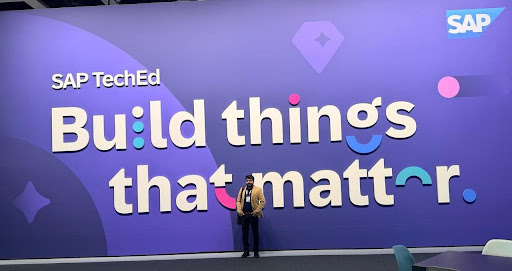
SAP TechEd 2026 in Berlin was less about new tools and more about one idea: AI that does the work, not AI that only helps with it. SAP calls it the Autonomous Enterprise. The keynote on 27 October filled in what was first sketched at Sapphire in Orlando.
I spent the 3 days in sessions, hands-on labs, and Community Talks. This blog highlights what I saw and learnt.
Keynote headlines
The keynote gave SAP’s AI story a clear shape: one front door (Joule Work), a big catalog of agents (Autonomous Suite), and one platform underneath (SAP Business AI Platform).
- Joule Work – A redesigned Joule that works across SAP and non-SAP apps. It connects out of the box to Office 365, Claude Cowork, Glean and ServiceNow. It remembers context and adds “Spaces” that turn a request into a small interactive app. It runs on web, desktop, mobile, voice, and Apple CarPlay. SAP says 110,000+ employees and 150+ Early Adopter Care customers have tested it.
- SAP Autonomous Suite – 40 assistants and 300 agents from SAP and partners. Examples shared on stage:
- Financial Consolidation Assistant: up to 68% shorter time to close
- Sourcing Assistant: 15% lower total cost of ownership
- Supplier Management Assistant: supplier risk spotted 60% faster
- SAP Business AI Platform – The base for building, extending and governing agents. Every agent is exposed as an Agent-to-Agent (A2A) endpoint.
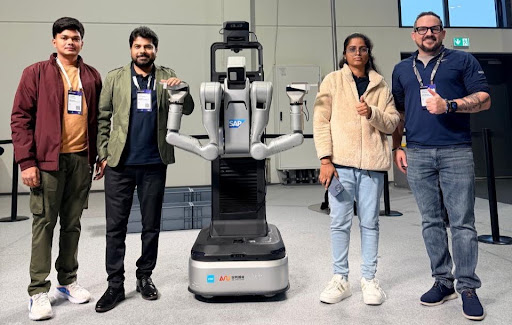
- Physical AI – Agents tied to robots and shop floors. Intel’s Chengdu site runs SAP warehouse management that drives robots and writes results back to SAP.
- Space AI with HPE – SAP’s tabular models running on live telemetry in space, flagging sensor problems and filling in missing readings.
Business AI and Joule: building and governing agents
Joule Studio is now the place to build agents, and governance has moved from presentation slides to a real product.
Joule Studio
- Skill-based agent building with natural language and a few lines of code.
- A Process Consulting Agent helps decide what to build before anyone writes code.
- SAP Knowledge Graph finds the right APIs, MCP servers, and data products for you.
- SAP says intent to working agent drops from about 13 hours to 2.5, with 50% lower cost per task in their testing.
- Supports 70+ models and n8n workflows (early adopter program for now).
- Agents deploy to the Joule Studio runtime and show up in SAP AI Agent Hub and Joule Work.
- New observability shows model usage and spend to developers and admins.
Free for now
- Custom agent runtime: free for select customers through December 2026
- Design-time tools and n8n workflows: free under fair-use limits
- Joule Studio Developer certification: free through 31 December 2026
Governance
- Agent Gateway is generally available. Third-party agents can call Joule agents through one governed entry point.
- SAP Enterprise AI Gateway (planned Q1 2027) adds authentication, policy, routing, monitoring, usage tracking, and audit for AI traffic. Pricing not shared yet.
- AI Governance Assistant produces an audit-ready risk classification under the EU AI Act. First to Early Adopter Care customers.
- Agents not verified in SAP AI Agent Hub cannot be invoked at runtime.
- Michelle Niedernhuber put it well: “Governance is not what slows AI adoption.”
Data: Business Data Cloud, Knowledge Graph and models
The data story was simple. Agents need business context, and SAP Business Data Cloud (BDC) plus the Knowledge Graph is how SAP plans to give it to them. Herzig: “Any AI system is only as good as the data it reasons over.”
| Item | What it does | Timing |
|---|---|---|
| SAP-RPT-TS | Time-series forecasting, for example, demand in SAP IBP | Generally available |
| SAP Databricks in BDC | Full Databricks inside BDC, Joule linked to Databricks Genie | Announced, no date |
| SAP Reltio | Multi-domain master data in BDC, a “golden” record | Announced, no date |
| Sovereign Cloud | AI Core, Joule and Datasphere in the UK, Australia, Canada | Q4 2026 |
| Joule for SAP HANA Cloud | Database administration help | Q4 2026 |
| SAP Knowledge Graph | Customer-specific context from SAP and non-SAP data | Q1 2027 |
| BDC Ontology Manager | Ontologies across SAP and third-party data | Beta, Q1 2027 |
| SAP-RPT-2.0 | Tabular model with anomaly and outlier detection | GA Q1 2027 |
| BDC lakehouse with Dremio | Apache Iceberg, Polaris, federated query | GA Q1 2027 |
Plans are subject to shift, so check the SAP Roadmap Explorer before committing to dates.
Build: what changed for developers
For developers, the message was that MCP and A2A are now normal parts of the SAP toolbox, and AI is moving into the code itself.
- Day 2 developer keynote – A coffee farm scenario showed how to give an agent new skills in Joule Studio and show it in Joule Work.
- MCP everywhere – Integration Suite can now turn OData APIs into MCP servers in a few clicks. Agents can reach external systems through MCP and A2A.
- ABAP and AI – An ABAP MCP server (version 1.2.0) exposes ABAP functions to coding agents such as Claude Code.
- Custom Code Migration Agent – Part of Joule for Developers. It reads ATC findings, groups objects by confidence (High, Medium, Low), and puts them into a transport. Developers review before activation.
- AI inside RAP apps – A “Recommendations” pattern uses an LLM to fill fields from one input. Suggestions show in the draft in blue, and users accept or reject them.
- Full-stack ABAP – ABAP developers are expected to know Fiori Elements and Fiori tools, not only the backend.
- Integration Suite adds error analysis, anomaly flags, Git operations, and automation for Gmail, Excel, and Salesforce Service Cloud.
- RISE with SAP gets AI-assisted implementation and onboarding tools.
- Traceability for agents and MCP servers was announced on Day 1.
Sessions I attended
I went to 17 sessions across keynotes, Joule Studio, Joule Work, data, and ABAP. Here is what each one covered.
Keynotes
- KEY100: Built for the ones who build – The main keynote, led by CTO Philipp Herzig. It laid out the Autonomous Enterprise: Joule Work as the front door, 40 assistants and 300 agents in the Autonomous Suite, and the Business AI Platform underneath. Agent Gateway went GA here.
- KEY101: Agent v0.0.7 – A license to skill – The Day 2 developer keynote. A coffee farm scenario showed how to give an agent new skills in Joule Studio and surface it in Joule Work. Mostly live demos, with MCP and A2A doing the plumbing.
Joule Studio and agents
- AD105: Joule Studio: Build, deploy, and manage agentic solutions. A full tour of Joule Studio from idea to running agent. It covered skill-based building, using the Knowledge Graph to find APIs and MCP servers, and deploying to the Joule Studio runtime and AI Agent Hub.
- AD263: Build your first agent with Joule Studio in a pro-code way. Hands-on build of an agent in code instead of low-code. It showed that pro-code agents use the same runtime, governance, and Agent Hub as the low-code ones.
- AD108: Agentic workflow orchestration with the managed service for n8n in Joule Studio. How n8n workflows run as a managed service inside Joule Studio. Useful for chaining agents and outside systems with fixed, predictable steps. n8n is in an early adopter program for now.
- AD101: Control, administer, and observe the lifecycle in Joule Studio. The admin side of agents: deployment, access, monitoring, and spend. The new usage and cost views answer a real worry customers have about AI bills.
Joule Work and user experience
- JW128: Joule Work in action: From custom apps to agents with real impact. Joule Work as one entry point across SAP and non-SAP apps. Spaces turn a request into a small working app. Scenarios came from Early Adopter Care customers.
- ST114: The user experience with Joule Work and the technology strategy behind it. The thinking behind Joule Work: intent-based UX, memory and context, and how it sits on the Business AI Platform. Good framing for anyone who designs for the first click.
- JW808: Roadmap for Joule: Building the foundation for AI-native work. Where Joule goes next. Joule Work features roll out in phases, with agent orchestration and Knowledge Graph updates lined up for Q1 2027.
- AD202 and AD266: Agentic UI development with SAPUI5 and how it relates to Joule Work. How SAPUI5 apps work with agents and show up inside Joule Work. It covered AI-assisted UI5 development and how existing Fiori apps can take part in agent flows.
- JW129: SAP’s compositional design system: Craft enterprise UIs with AI on the fly. SAP’s design system for UIs that AI puts together at runtime. It is what keeps generated Spaces in Joule Work looking and behaving like Fiori.
Data and AI platform
- DA164: Building agentic applications with SAP HANA Cloud. Using HANA Cloud as the data, vector, and graph store behind agents. It also previewed Joule for HANA Cloud database admin, planned for Q4 2026.
- RA107: SAP AI Core deep dive: Models, agents, and business context at scale. How AI Core hosts models and agents and grounds them in business context. It also covered SAP’s own tabular models, SAP-RPT-2.0 and SAP-RPT-TS.
ABAP
- AD100: Agentic AI development with ABAP development tools. AI agents inside ADT for day-to-day ABAP work. It covered Joule for Developers and the ABAP MCP server that connects coding agents to ABAP systems.
- AD160: Build apps and web APIs with ABAP Cloud using agentic AI. Generating RAP objects, services, and Fiori apps with AI in ABAP Cloud. It included the Recommendations pattern that fills fields with LLM suggestions in the draft.
- AD819: Roadmap for agent-led ABAP development. Where ABAP tooling is heading. The highlight was the Custom Code Migration Agent, which works from ATC findings and groups fixes by confidence for review.
My takeaways
The technology is moving fast. The hardest part now is data, governance, and getting people to use it.
- Context beats model choice – Every demo that worked had clean SAP data and business context behind it. Fix master data and data products first.
- Agents are becoming the new UI Layer – Joule Work wants to be the front door. Design for the first click, or people will go back to the old screens.
- Open standards are real now – MCP and A2A protocols showed up in Integration Suite, ABAP, and Joule Studio. The plan is for SAP and non-SAP agents to talk to each other.
- Governance is a feature, not a blocker – Agent Gateway, AI Agent Hub, and the EU AI Act assistant mean you can build controls in from day one.
- Developers go full stack – ABAP, CAP, Fiori, and agent skills now sit in the same job. Upskill teams across all of it.
- Watch cost – Use the free runtime and certification window through December 2026 to learn cheaply.
- Mind the dates – Much of this is beta or planned for Q4 2026 and Q1 2027. Customers and partners can pilot now, scale when it is GA.
What I would do next
- Pick one process with clean data and pilot a Joule Studio agent from Low Code to Pro Code.
- Get the team through the free Joule Studio Developer certification before 31 December
- Try the OData to MCP server feature in Integration Suite
- Map which agents in the Autonomous Suite fit our current customer projects.
- Talk to customers about their blockers to start their Joule journey and help them get the most out of it.