Design Thinking / Accounts Payable
Financial Services
A global financial media company redesigns its vendor invoice approval system with Design Thinking
Multinational Media Corporation Delivered 2018
Mindset ran a full Design Thinking cycle to turn a fraud-prone vendor invoice approval process into a simpler, faster system, cutting processing time and reducing duplicate effort.

By the numbers
-
Significant
Reduction in invoice processing time
-
Significant
Reduction in duplicate effort
-
Increased
User adoption of the new invoice system
Before
Invoice approvals without the context to get them right
- Vendor invoice system missing critical vendor information at the approval step.
- Invoices approved inaccurately, creating exposure to fraud, duplicate payments, and delayed vendor payments.
- Litigation and reputational risk from late payments, with no clear path to fixing the underlying process.
After
A redesigned system built around how approvers actually work
- Vendor context surfaced at the point of decision, so approvers have what they need to act accurately.
- Processing time and duplicate effort both reduced significantly.
- Internal IT team trained in Design Thinking and Agile to carry the approach forward.
Why this matters
Design Thinking applied to a financial controls problem: turning a fraud-prone approval workflow into a user-friendly system by going on-site, watching how approvers actually work, and building toward what they need.
The challenge
A global financial media and technology company was dealing with a real problem in its accounts payable workflow. Its vendor invoice management system was missing critical vendor information at the point of approval, so invoices were routinely approved without the context needed to catch errors. That created direct exposure: potential fraud, duplicate payments, and delayed vendor payments that carried litigation and reputational risk.
The system was not serving the people who had to use it. Approvers could not see what they needed to see, and the result was inaccurate decisions made in good faith. The company needed a redesign that put the right information in front of the right people at the right time.
What we did
Mindset ran its Design Thinking process end to end. The engagement started with structured interviews to establish a baseline understanding of how the current system was being used and where it broke down. The team then went on-site to observe actual users in their environment, building direct empathy with the people doing the approval work.
From that field research, Mindset refined user personas and sharpened the problem statement to reflect what was actually happening rather than what the original brief assumed. The team then built low-resolution prototypes to test how a redesigned system would function, gathered feedback, and iterated into a high-resolution interactive prototype that showed the solution in working detail.
Users ran through real approval scenarios on the prototype, feeding back adjustments that shaped the final design. Alongside the redesign work, Mindset also trained the company's IT staff in Design Thinking and Agile methods, so the approach could carry forward internally.
The outcomes
The redesigned invoice management system was simpler and far more user-friendly than what it replaced. Approvers had the vendor context they needed at the point of decision, which addressed the core vulnerability.
The named outcomes were increased user adoption of the new system, a significant reduction in duplicate effort across the team, and cost savings from avoiding the litigation and reputational issues tied to late or incorrect vendor payments. Invoice processing time dropped significantly.
If we built this today
Concept · not delivered scopeApprove invoices with the full picture.
This is a forward-looking concept, not the scope we delivered on this engagement. It is the build we would reach for now, grounded in SAP that ships today.
This media company's approvers were signing off on vendor invoices without the vendor context they needed, which let duplicates, fraud, and late payments slip through, so today we'd put that missing context and a discrepancy check right where the decision happens.
The data product
Working Capital Insights
Grounds the agent in unified AP, supplier, and payment data so duplicate-payment patterns and aging vendor balances are scored against real history, not just the single invoice in front of the approver. It gives the reconciler the prior-payment context that was missing at the point of decision.
Intelligent Application on SAP Business Data Cloud
The Joule agent
Invoice Discrepancy Reconciler
Reads each incoming supplier invoice against the PO, goods receipt, vendor master, and prior payments, then flags missing vendor data, duplicate risk, and price or quantity mismatches before approval. It drafts the matched result and the exceptions to review so the approver decides with everything in one place.
SAP S/4HANA Finance (Accounts Payable), SAP S/4HANA Sourcing and Procurement · PROPOSE · Invoice processing time and duplicate-payment rate
The Fiori app
Supplier Invoice apps with embedded Joule
The standard SAP S/4HANA supplier invoice screens now surface the agent's match result, the missing-vendor and duplicate flags, and a plain-language explanation inline. The approver sees the full vendor and three-way-match picture without hopping between systems.
Released through Joule in the Fiori launchpad
We'd mine the real approval flow in SAP Signavio first to see where vendor data goes missing, map the AP application landscape in SAP LeanIX, and let our MIND accelerators carry the personas and prototype logic from the Design Thinking work into the new build.
What we built
-
Direct user empathy and a grounded problem definition
User research and field observation
Structured baseline interviews followed by on-site observation of approvers in their actual working environment, producing detailed user personas and a refined problem statement.
-
Iterative feedback loop before any high-cost design work
Low-resolution prototype testing
Early-stage prototypes defining how the redesigned invoice system would function, tested with real users to surface issues before high-fidelity work began.
-
Validated design ready for build handoff
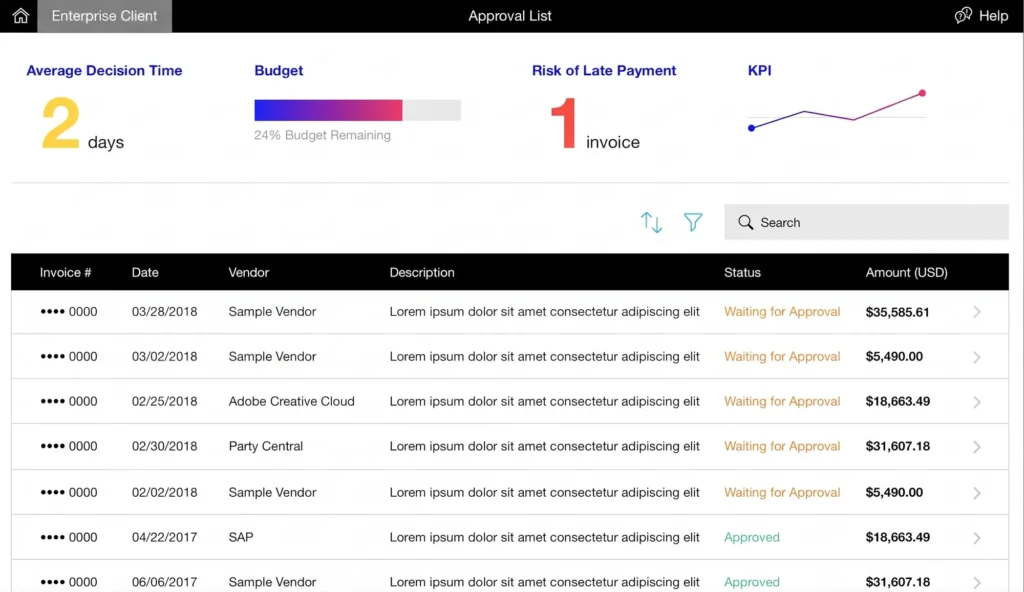
High-resolution interactive prototype
A fully interactive prototype defining the redesigned invoice approval experience in working detail, with vendor information surfaced at the point of decision.
-
Internal capability built alongside the project
Design Thinking and Agile training
Trained the company's IT staff in Design Thinking and Agile practices so the methods could be applied to future challenges internally.
A look at the work