
This year, we hosted two SAP Embedded AI roundtables: one in May, and another in November with a specific focus on AI in Fiori. Across both conversations, a clear pattern emerged: whether organizations are still on ECC, mid-migration, or already live on S/4HANA, everyone is trying to make sense of SAP’s evolving AI landscape.
And I get it—the pace is intense. SAP is rolling out new embedded features, agentic patterns, Joule capabilities, and UX shifts faster than most teams can absorb. That’s exactly why we created these roundtables: to bring people together across roles, industries, and levels of AI maturity, and create space to compare notes and learn from each other.
Organizations are no longer asking, “Should we use AI?”. They’re asking, “How do we adopt it securely, practically, and in a way that truly helps our people?”. As someone who spends every day listening to teams navigate this space, these sessions offered a valuable snapshot of where the SAP ecosystem stands today, and where it’s heading next.
Here are the reflections and discussion patterns that stood out.
May was about orientation: “Help us understand the landscape”
Our May session had an exploratory energy. Folks were collectively trying to decipher SAP’s fast-moving AI ecosystem. People were curious, a bit overwhelmed, and really trying to figure out where to start.
A need for direction
Developers asked how ABAP skills translate into AI work, functional teams wanted clarity on embedded AI, and ECC users wondered what’s even possible. These questions highlighted the need for clearer learning pathways before teams can confidently take the next step.
Overwhelmed by AI pace
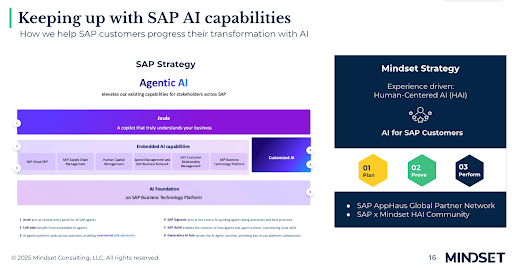
The rollout of Joule, Embedded AI, ISLM, Gen AI Hub, and agentic capabilities reflects SAP’s fast AI evolution, but customers struggled to see how they fit together. We clarified the multiple layers of SAP Business AI—embedded AI you activate, Joule you interact with, and SAP BTP AI Foundation to extend and orchestrate—along with how generative AI helps you understand, agentic AI helps you act, and Work Zone with Joule ties the experience together (see Fig. 1).
Practical use cases tied to SAP business processes
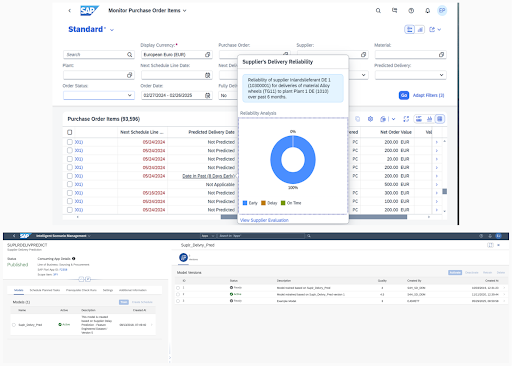
Customers wanted to see where AI actually lives in S/4HANA—through demos, workflows, and activation steps—especially in payment processing, sales order creation, exception handling, and supply chain planning. Requests for delivery date prediction (Fig. 2), payment exception handling, and sales order extraction showed a clear appetite; teams simply need guidance surfacing the right embedded scenarios and prioritizing those tied to real pain points.
Change Management considerations
A real scenario made this clear: embedded AI for expense management was activated in Concur without business or IT realizing it, causing the system to auto-reject expenses simply because users didn’t understand the new requirements. It wasn’t a technology issue—it was a communication gap. It emphasized how essential it is to prepare and support people before AI-driven processes go live.
Security, trust, and governance concerns
Questions around hallucinations, auditability, and guardrails came up repeatedly. Teams want AI that’s safe, auditable, and grounded in ERP data with proper privacy controls. It reinforced that responsible AI isn’t optional—organizations need clear trust boundaries early so they can adopt embedded AI with confidence.
Having SAP’s Doug Freud with us, who is VP Data Science & Data Management for BTP, grounded the conversation, especially around what SAP is delivering now versus what’s emerging. He brought clarity and direction to a space that often feels abstract and uncertain.
In hindsight, May reflected an industry that is still mapping the terrain.
By November, the conversation shifted: “Help us get going”
Our November session felt different—more concrete; almost like the industry had caught up with itself over the summer. With Regina Sheynblat who is Sr. Product Manager, SAP Design, walking us through Fiori’s embedded AI features, the conversation moved beyond understanding the landscape to planning actionable next steps. People were no longer asking, “What is AI in SAP?”. Instead they asked, “How do we bring this into our environment, and when?”
SAP Fiori + AI finally felt tangible
With features listed below, AI no longer felt theoretical. Regina’s demos showed exactly how these capabilities were embedded in the User Interface (UI) that people use every day, such as the Cost Center Review enabled by AI (Fig. 3). This signaled that teams would benefit from early hands-on exposure, so end-users can feel the improvements directly rather than hearing about them abstractly.

Work Zone + Joule resonated well
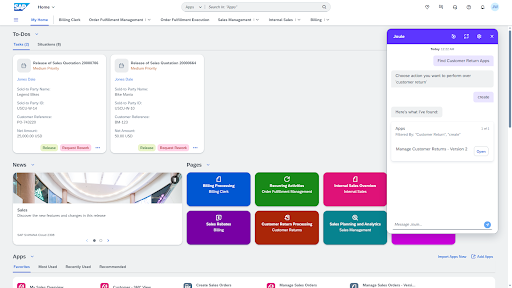
The idea of Work Zone as a unified launchpad and Joule as a conversational entry point made sense. Once folks saw how Joule can retrieve tasks, guide navigation, or summarize insights without traditional app-hunting, the workflow potential became obvious. This means that organizations should begin evaluating their UX strategy, so they can plan how Work Zone and Joule will gradually become the primary entry point for SAP interactions (see Fig. 4).
Migration emerged as the moment for AI adoption
More than 60% of attendees were either migrating or already live on S/4HANA. The takeaway was clear: S/4 is the tipping point for adopting embedded AI. It became clear that embedded AI adoption is much better when teams modernize their processes during migration. Features like AI-assisted error explanation, predictive insights, situation handling and automatic extraction (Fig. 5) are far easier to activate when teams are already aligning roles, data, and workflows for S/4HANA. This highlights the value of integrating AI exploration into the migration journey—not after go-live—when the organization is already primed for change.

Teams wanted clarity on reality, not hype
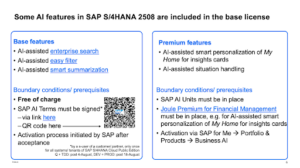
People were asking: What’s public cloud only? What’s premium vs base AI features? What’s GA vs beta? What won’t be delivered to on-prem? Regina’s candid breakdown of availability and licensing helped teams separate marketing language from what’s actually deployable today (see Fig. 6). This shows how important it is for organizations to maintain a clear AI capability map, so they can prioritize realistically and avoid planning around features they can’t access.
AI maturity is not about tools — it’s about willingness to redesign work
Across the discussion, it became clear that AI readiness isn’t determined by how many features an organization has activated, but by how willing they are to rethink their processes. Embedded AI shines where teams are open to reimagining workflows, roles, and decision points — not just automating the old way of doing things. This reinforces the idea that AI adoption is as much a leadership and culture capability as it is a technology upgrade.
Overall, November felt like the moment the industry collectively saw how AI in SAP is not theoretical anymore, and that the pioneers are already taking advantage of what’s available.
Connecting the dots across both conversations
Looking across both sessions, several threads kept surfacing:
AI readiness varies, but interest is universal
We saw three groups form naturally:
- Ready now (S/4 live, strong Fiori adoption)
- Ready soon (migration teams)
- Ready to learn (ECC users or early-stage AI teams)
Regardless of where SAP customers are, it was clear that everyone is moving.
SAP’s roadmap is moving fast, and customers want guidance
Between AI agents, new embedded features, Joule Studio, and UX transformation with S/4HANA, SAP is moving quickly. Customers need help prioritizing what’s relevant.
Governance & trust matter just as much as functionality
Organizations want AI they can control, audit, and understand—not AI that feels mysterious or risky. They want AI to be safe, transparent, and well-designed.
Human-centered design is the difference between promise & impact
AI adoption isn’t failing because of the technology. It fails when people’s needs are assumed—often incorrectly—and aren’t considered as part of the solution design, let alone brought along thoughtfully.
Change management is immensely underappreciated
With so much focus on technology—while warranted—there’s little attention on how to mobilize the people who use SAP every day. Leaders want to innovate with AI, but they also worry about resistance from long-tenured employees who are comfortable with existing processes, even when those processes are inefficient. Beneath that resistance is often a deeper fear of becoming less relevant, which needs to be addressed thoughtfully. Our guest speakers reinforced that successful AI adoption depends on how intentionally organizations bring people along.
What this means for SAP customers in 2026
Here’s how I’m interpreting the signal beneath the noise:
- AI needs a foundation — Teams need clarity on versioning, integration, SAP BTP readiness, UX strategy, data models, and governance before AI can scale.
- SAP’s experience is shifting from click-driven to intent-driven — The combination of My Home, Work Zone, and Joule is reshaping how people navigate SAP systems.
- Agentic AI is coming faster and changing workflows — SAP’s expansion of agents and the Joule Studio will shift work from ‘clicking through screens’ to ‘providing better outcomes’. We are seeing how AI is not just assisting, but executing and orchestrating work autonomously.
- S/4HANA migration is the ideal moment to embed AI thinking — Organizations that integrate AI during migration will outpace those that retrofit it later. Not after go-live, not down the line, but during transformation before processes re-solidify.
- Human-centered design is non-negotiable — It’s the only way to build trust to ensure AI adoption and minimize risk of shelfware. AI will only succeed when people feel included, empowered, safe and clear on how it helps them do their jobs.
Gratitude to Our Co-Hosts & Guests
A big thank-you to our esteemed SAP partners Doug Freud and Regina Sheynblat, who graciously shared their expertise and guidance. Also from Mindset: Ethan Jewett, Paru Sankar, Robb Neuenschwander, Abesh Bhatterjee, Paul Modderman, as well as Amy Lund and Katie Kinde for meticulous behind-the-scenes work . And of course all the 200+ participants across various industries who helped shape the dialogue. The collective effort and perspectives made these sessions richer and more grounded that our community clearly valued.
What’s Next
One theme kept returning throughout both sessions: Organizations aren’t asking if they should use AI—they’re asking how to adopt it meaningfully.
This echoes our CEO’s vision and emphasis:
AI isn’t here to replace human expertise; it’s here to elevate it. It should create competitive advantage, strengthen teams, and modernize processes—without losing the human element that makes organizations succeed.
That belief shapes how we’re helping organizations move forward:
- AI Readiness & Roadmap Assessments – Helping teams build clarity and confidence about where AI fits, and where it doesn’t
- Human-Centered AI Use Case Workshops – Ensuring AI solves real problems for real people using SAP AppHaus innovation toolkit
- Fiori + AI Enablement Programs – Demystifying SAP’s new UX landscape, building comfort with My Home, Work Zone, and Joule’s evolving role
- Embedded AI Activation Sprints – Turning on and guiding with what you already own: ISLM models, embedded ML, AI-assisted Fiori features
- Agentic AI Design & Build with Joule Studio & SAP BTP – Creating responsible & auditable agents that actually make people’s work a whole lot better
- S/4HANA Migration + AI Strategy Alignment – Embedding AI thinking at the moment when processes and systems are already being reimagined
- AI Governance & Ethics Framework – Establishing policies and procedures that ensure AI initiatives meet compliance requirements, data privacy standards, and ethical AI principles.
Looking Ahead
If 2025 was the year the SAP community oriented itself around AI advancements, 2026 will be the year organizations start activating it with intention.
SAP’s roadmap isn’t slowing down. And organizations know the stakes: AI isn’t simply another technology wave, it’s a shift in how people will work with SAP technology.
And our role—what I see as Mindset’s responsibility—is to guide teams through this journey with clarity, empathy, and a human-centered approach that puts people at the center of every decision. That’s the work I’m personally excited to continue.
If you’re ready to explore what AI could mean for your SAP landscape, your teams, and your transformation journey, we’d love to connect.
