
Centers of Excellence should be passionate human communities rather than asset repositories, proving that the real competitiveness in the age of AI isn’t just technology – it’s knowledge and passion.
Currently, we are seeing a strong shift in the enterprise software world – one of the most powerful shifts this generation has witnessed. In the SAP world, we are talking about the transition to cloud-native development on SAP BTP, the rise of AI-powered automation through Joule, and the shift toward composable analytics and low-code delivery are fundamentally changing how global businesses operate.
To address this shift, we need to bring together the best minds of the world to collaborate with passion. For technology consulting companies like ours, the shift brings forward massive opportunities to innovate provided we address one big gap – left to own devices, especially in this hybrid working environment, human learning is strictly local.
Traditionally, a team might build a masterful, complex data model or a highly customized AI agent for a specific client, but once the engagement ends, that hard-won knowledge remains locked in the developers’ heads or buried in an isolated project folder. Months later, another team halfway across the world will inevitably start a nearly identical project from absolute zero. Firms have historically tried to solve this knowledge drain by deploying Confluence wikis or top-down knowledge management systems, treating practitioners as mere inputs for an “asset factory”. Now we can search this using AI – yet, these are all retrospective actions required, by which time, very often, the knowledge has already been relegated to the back of the mind.
Start With the People, Not the Roadmap
When we try to build COEs with an output in mind like a pattern library, people will build a structure that produces something with outcome in mind already. The output should be the side effect. The cause should be the people who are genuinely passionate about integration architecture, or data modelling, or what AI agents can actually do in a procurement workflow – people who want to be in a room where others share that fascination. Give those people a home, a rhythm, and permission to build on each other’s ideas, and the reusable assets emerge naturally.
Start with the people. Understand what motivates them. Design the community around their real needs. The assets — the accelerators, the patterns, the toolchain — are what emerge when you get that design right.
Hence, we decided to move to a radically different approach, moving from a repository only mindset to a community mindset. We understood that the key to compounding knowledge lies in designing for human behavior first, building structures around practitioners’ natural curiosity and to build an innate desire to share their craft.
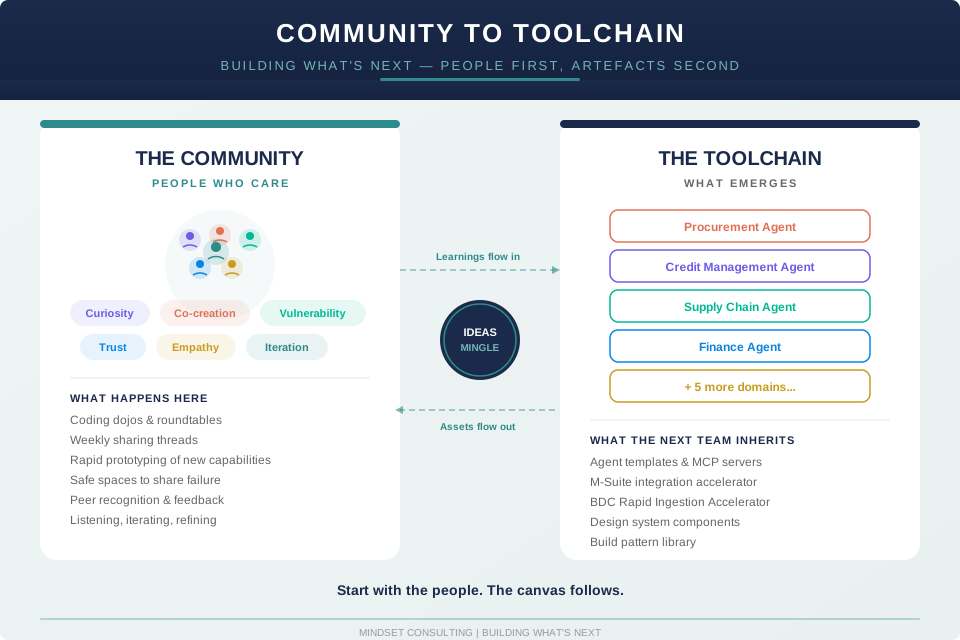
The Community-First COE Model
Mindset designed global Centers of Excellence (COEs), mapping to the critical capability domains of the modern SAP landscape: SAP Build, Business Data Cloud (BDC), Integration Suite, and upcoming cross topics COEs – Joule & SAP AI and AppHaus. These COEs are permanent, globally distributed communities designed as a “place of engagement” for practitioners genuinely passionate about their specific technological domains.

Each one is global, asynchronous, and permanent. And each one is beginning to produce things that surprise even us – not because we planned every output, but because we built the conditions for passionate people to jam together with real problems.
The central design principle behind these COEs is simple: People first, artifacts second.
For example, the Integration Suite COE – which tackles some of the most complex architectural challenges – fosters engagement through a recently launched weekly “Sharing Your Work” initiative where practitioners post brief, honest updates about their current live-project challenges and discoveries, effectively cross-pollinating ideas in a space where vulnerability is respected.
Similarly, the SAP Build COE runs virtual “coding dojos” – intensive, collaborative sessions where developers across different time zones build real solutions together in real time, transforming a roster of names into a deeply connected community.
The Flywheel Effect: From Live Projects to Accelerators
We want to turn this vibrant community culture into an engine to convert this energy into tangible, repeatable business value. This can be designed as a four-stage “Flywheel”. The process ensures that every technological breakthrough made in the field is systematically absorbed by the wider organization:

Deliver: Everything begins in real customer engagements. Teams develop novel approaches to solve real production challenges, establishing credibility because the solution is created in live environments.
Capture: Learnings are surfaced organically. Because the COEs are high-trust environments, developers can naturally share their successes and failures – such as the Analytics COE’s roundtables where practitioners openly dissect where specific technical approaches “fell over”.
Codify: This is where community insights turn into enterprise-grade tools. COE leads and senior practitioners will run ideas for these tools through rigorous quality gates. A clever, one-off configuration discovered on a client site is refined, generalized, and parameterized for reuse.
Distribute: The newly created asset is pushed back out to the organization. When the next project kicks off, the new delivery team inherits a proven starting point to extend and make their own.
The faster this flywheel spins, the more each new customer benefits from the compounding knowledge of every customer that came before them.
Delivering Tangible Accelerators
The output of this human-centric model is an arsenal of accelerators that allow the practice to scale its impact building on the passion of our development pool.
In the Business Data Cloud COE, practitioners took the tedious, manual work of configuring data replication flows and codified it into the BDC Rapid Ingestion Accelerator – a framework that generates complete data ingestion pipelines from a single configuration file.
In the Integration COE, the accumulated wisdom of the community birthed M-Suite, a curated library of pre-built integration flows, API templates, and error-handling patterns.
The most striking example of this model’s power resides in the Joule & SAP AI area (upcoming cross COE). What started as four hand-built AI servers for individual clients was brought back to the community, debated, refined, and codified into a massive production infrastructure. Today, this architecture features nine Multi-Agent Connectivity Protocol (MCP) servers on BTP Cloud Foundry, exposing 144 enterprise tools that power 20 validated Joule agents across supply chain, finance, and warehouse operations. Because the community captured and codified the precise conventions for building these servers, an AI coding assistant can now read an SAP OData specification and autonomously produce a production-ready server end-to-end.
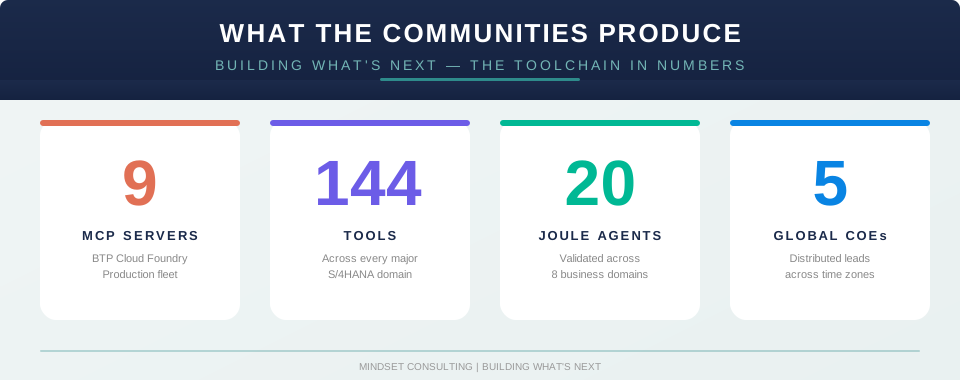
As Mindset’s VP of Products, Jonathan Bragg noted about this staggering infrastructure: “The AI is the leverage. The expertise is ours.”
Rippling Outward: Engaging the Broader SAP Ecosystem
Remarkably, the energy generated by Mindset’s internal flywheel is not contained within the firm’s walls. Grounded in the human-centered design philosophy of the AppHaus COE – Mindset was the first US-based SAP AppHaus partner – the firm actively spills its internal culture into the external SAP ecosystem.
Mindset practitioners in the COEs regularly host informal Mindset Roundtables globally and physical SAP Community Stammtisch events in our offices, bringing together developers and architects from across competing companies for low-friction, high-trust knowledge sharing. The firm organizes full-day UX Innovation Summits, sponsors SAP Inside Track events, and delivers highly-attended sessions at SAP TechEd on topics ranging from design thinking to human-centric AI.
This outward engagement helps reach the passionate people in the SAP Community to share their craft. Crucially, this external participation creates a secondary flywheel, leaning into the passion of a community to strengthen the SAP practices across the globe.
The Ultimate Competitive Advantage
In the AI era, where generative tools can write code and stand up servers in seconds, the sheer act of building software is rapidly becoming commoditized. We realize that the true value of a technology firm now lies in the collective passion and judgment of its community.
By building spaces where people actually want to show up, learn from their projects, and rigorously codify their insights, Mindset wants to build a compound interest of a community learning together, on purpose, transforming a standard consulting practice into an unstoppable delivery engine.
Build the room first. The canvas follows.


