
When you think about what’s glamorous about Agentic AI, we think of a world where everything gets done promptly, instantly and we have easy answers to it all. Yet, in an enterprise context, there are often discrepancies leading to accusations of the agents hallucinating.
The unglamorous part of data reconciliation, governance and lineage done within a context is what determines whether AI is a visionary tool or corporate liability.
Why Enterprise Bots Are Confidently Wrong
AI agents like SAP Joule promise unprecedented speed, but they are exposing a deep-rooted crisis in enterprise data architecture. Here is why the most critical AI project isn’t about AI at all.
I am in a modern enterprise boardroom. The CFO needs a critical metric and asks an AI agent, such as SAP Joule, for the Q1 revenue figures. The answer comes back in three seconds, delivered in plain English, fluent, and confidently stated – this is exciting!
Yet, simultaneously, the financial controller pulls the same metric directly from the S/4 universal journal, and the two numbers disagree by 4%.
The immediate assumption is often that the AI has hallucinated, but the reality is far more concerning: the agent did not hallucinate – it faithfully reported a number from an enterprise system that was simply never reconciled with the actual system of record.
This scenario represents a looming crisis of trust about the single version of the truth. It is not fundamentally an AI problem. It is a data architecture problem that AI has just made visible and embarrassing in real time.
Today, 67% of CFOs cite data trust as the top barrier to AI adoption, and for good reason. As enterprises rush to deploy Agentic AI, they are discovering that skipping the unglamorous data reconciliation work guarantees the deployment of bots that are fast, fluent, and confidently wrong.
The Death of the Human Safety Net
Before the rise of autonomous agents, humans were the safety net. A trained analyst would query a system, notice a discrepancy, reconcile it against the source of truth, and quietly fix the issue before the report ever reached the CFO. Inconsistencies existed, but they were hidden by the process of manual review cycles.
Agentic AI removes that buffer. When a CFO asks a tool like SAP Joule a question directly, the response is immediate. Furthermore, these agents are moving beyond simple reporting; they are beginning to act—triggering workflows, updating forecasts, and creating board decks. One bad data point now cascades into wrong actions at machine speed.
“Wrong data at machine speed, with machine confidence, is thesingle greatest risk to AI adoption in the enterprise today.”
The Fragmentation of the Truth
Real enterprise landscapes are messy. They consist of decades of data spread across S/4HANA,legacy BW, SuccessFactors, Ariba, and third-party solutions like Salesforce or Workday. An agent does not inherently know which source is canonical; it only knows what it can reach. Without explicit governance over which system “wins” for a specific data domain, companies are merely automating the propagation of ambiguity.
In fact, 73% of enterprises maintain data in three or more systems completely outside the SAP ecosystem, and the average data synchronization lag in federated SAP landscapes is 48 hours.
Without explicit governance dictating which system “wins” for which specific data domain, connecting an AI agent merely automates the propagation of ambiguity.
Architecting the Reconciliation Layer
Every SAP customer deploying agentic AI should be designing against this scenario before a single agent goes live. The architectural imperative is building a robust semantic and governance layer. To bridge the “Data Trust Gap,” organizations must stop focusing on the agent and start focusing on the reconciliation layer. SAP Business Data Cloud (BDC) serves as this essential foundation. It is not merely another data warehouse, but a semantic and governance layer that sits across all sources.

When deploying Agentic AI into the enterprise environments, there is a need to shift from data requiring human mediation to programmatic and system level governance to ensure quality. There is a 48 hours of average synchronization lag that needs to be handled.
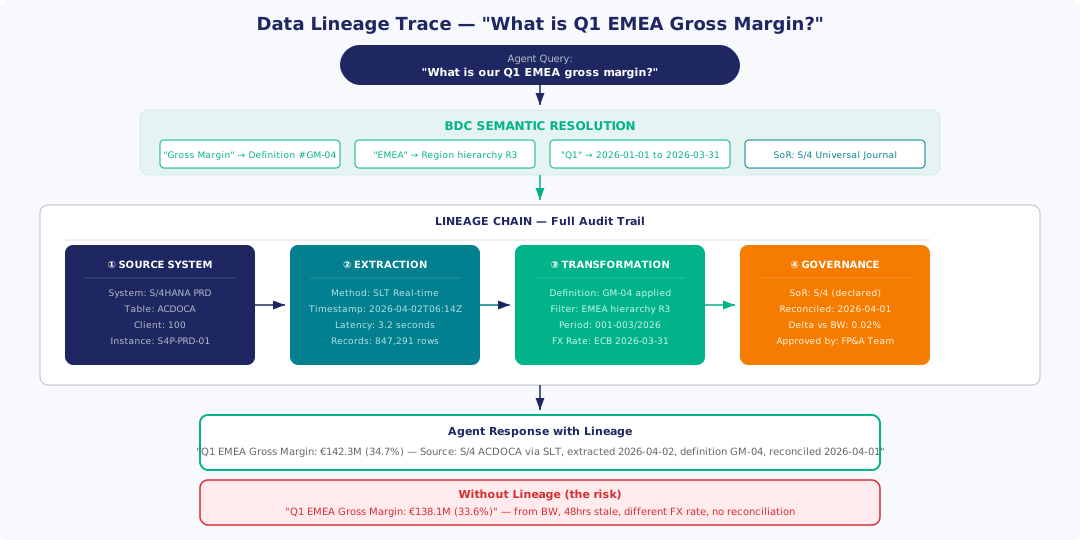
When an AI agent asks for the “gross margin for EMEA,” BDC prevents it from querying five different systems and picking the fastest answer. Instead, it resolves the question against a strictly governed definition.
This trustworthy AI architecture relies on four core capabilities:
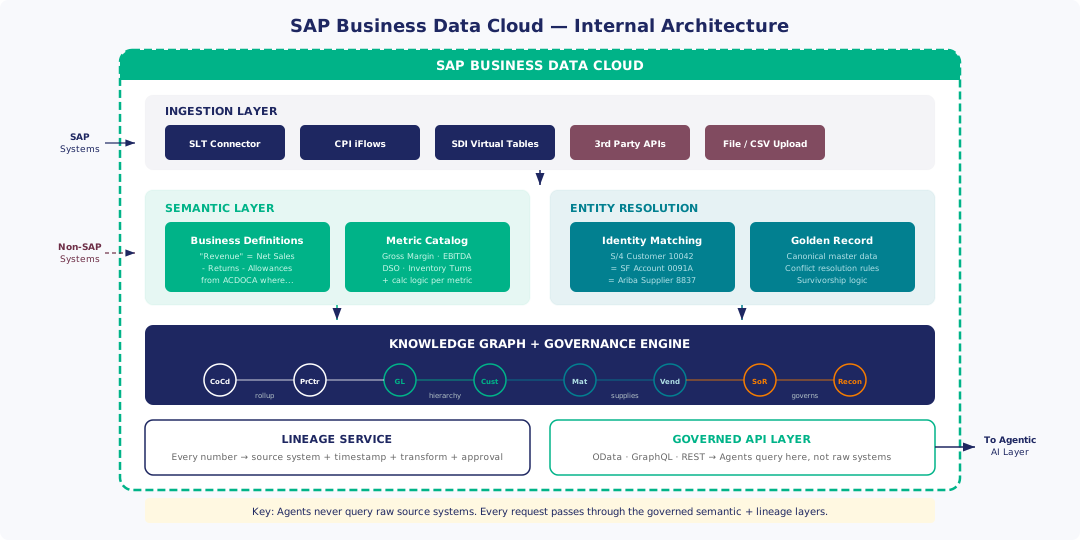
- A Semantic Layer: Establishes governed definitions and vocabularies.
- Entity Resolution: Matches identities across systems to create a golden record (e.g., ensuring an S/4 Customer, Salesforce Account, and Ariba Supplier are recognized as the same entity).
- Federation and Governance: Enforces system-of-record declarations and reconciliation rules. Knowledge Graph Engine establishes validated schemas for cross-domain entity relationships.

Lineage Metadata: Provides an audit trail for every single data point. When an agent provides a number, the system can trace the source system, the extraction timestamp, the transformation rules applied, and the individual who approved it as canonical.
The Automation Imperative
While BDC provides the theoretical framework for trustworthy AI, making it a reality is a formidable operational challenge. Without acceleration, manually setting up replication flows and hand-building pipelines takes weeks per data source, leading to fragile architectures, locked-in tenants, and no visibility into premium outbound costs.
To make this architecture practical, enterprises are turning to automation suites like Mindset Accelerators. These purpose-built tools act as the data layer’s immune system, turning weeks of manual configuration into automated deployments.
At Mindset, we’ve been building accelerators that tackle these friction points head-on.
Typically, questions on costs stall projects. Premium Outbound Integration charges based on data volume, but most organizations don’t know what their bill will look like until it arrives. Our estimation accelerator answers that question upfront, before replication begins and recommends optimization strategies that can significantly reduce spend. No more budget surprises. No more procurement limbo.
The configuration work is not something anyone wants to do. Setting up replication flows, tables, and delta logic for each data source is tedious, repetitive, and error-prone. Our Ingestion Accelerator compresses that setup into a single configuration. What used to take weeks of manual work now happens in one automated run.
There is migration that SAP doesn’t support. Here’s something most customers don’t realize: if you provisioned your Datasphere tenant too large, SAP won’t let you scale it down. The only option is migrating everything to a new, right-sized tenant — a scenario SAP says you have to handle manually. We built an accelerator that automates it.
These aren’t flashy demos. They’re the practical tools that turn “AI-ready” from a PowerPoint promise into a deployed reality.
Because the unglamorous half of Agentic AI is where real adoption happens.

The Real AI Mandate
If an enterprise is planning an agentic AI initiative, the mandate is clear: do not start with the agent. Start with the data layer. The underlying data reconciliation, governance, and lineage work is not a prerequisite that can be skipped; it constitutes 80% of the actual project.
The glamorous half of Agentic AI is the prompt and the answer. The unglamorous half is everything between the question and the number that makes that answer correct. Organizations that invest in this unglamorous data architecture will be the only ones capable of building AI agents trustworthy enough to put in front of a board.
“Nothing in life is as important as you think it is, while you are thinking about it” – Daniel Kahneman in Thinking, Fast and Slow. Agentic AI is System 1 – fast, Intuitive, effortless. Data foundations are System 2 – alow, deliberate and unglamourous.
The industry is thinking about System 1. The winners will be the ones who invest in System 2, first.
* All illustrations are courtesy AI
Interested in learning more?
Visit Mindset’s Linkedin
Visit Mindset’s Blog Library
Visit Mindset’s YouTube Page


