In late April, SAP reopened the SAP AppHaus in Walldorf, Germany in Building 5. It’s a new space with an explicit focus on agentic AI. Kathrin Tarnai-Sindl, who leads Customer Engagements across EMEA/MEE/APAC, framed the studio as “especially relevant for AI solutions and the business opportunities brought about by agentic AI.“
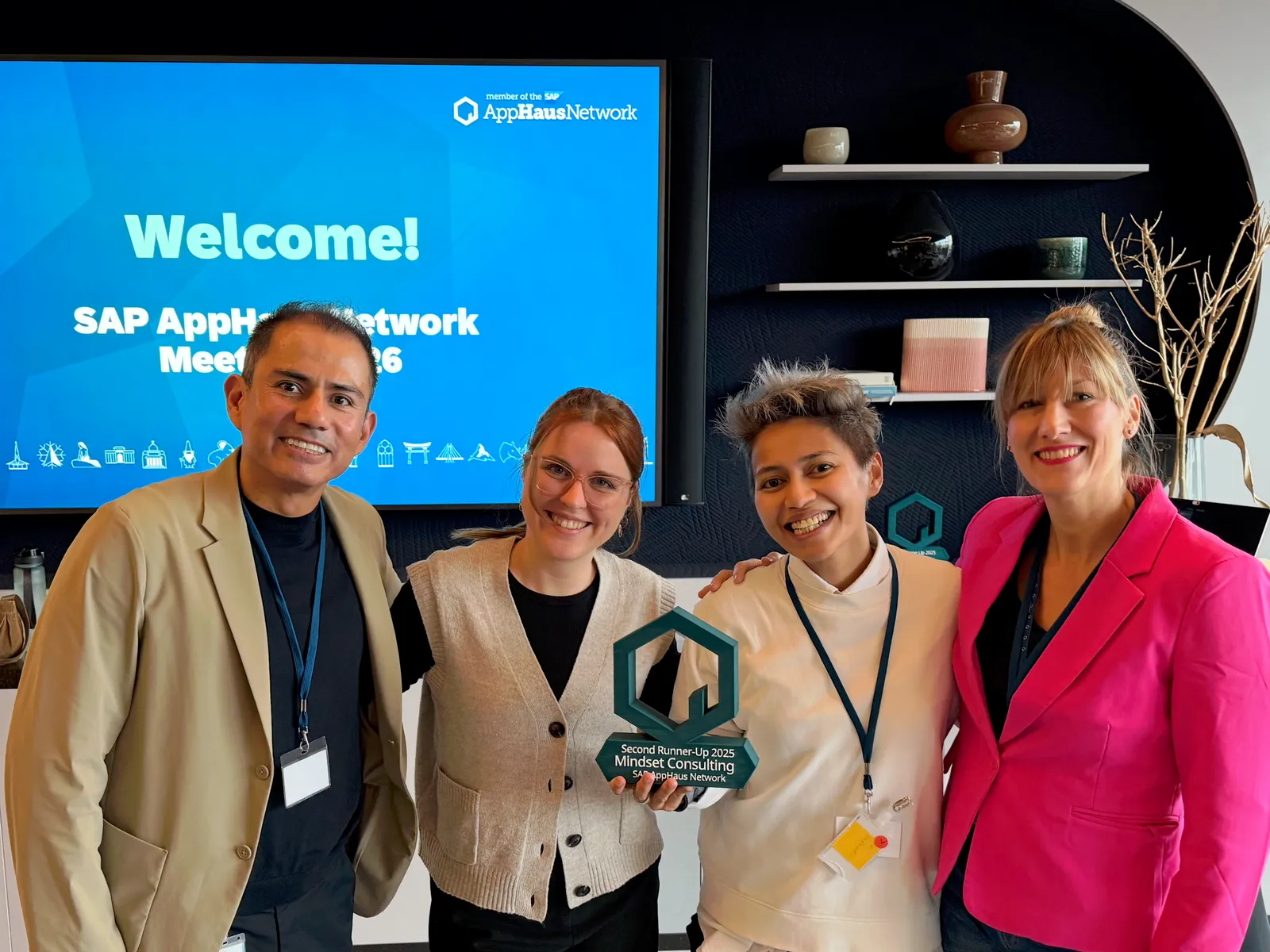
Mindset was the first SAP AppHaus partner in the United States since 2010. So when SAP says “design is back at the center of how we want partners to build AI,” that isn’t a pivot for us. Rather, it is our home turf—the place where we have always put human-centered design at the heart of everything we do. Our work continues to be recognized within the global innovation community where most recently, we were honored with an award at this year’s SAP AppHaus Partner Meetup in Germany.
The biggest shift is structural. SAP AppHaus now sits inside a wider organization called SIX (SAP Industries & Experience), alongside SAP Experience Centers and Co-Innovation Services. These three branches are being pulled closer together. Customers are being brought to physical locations more deliberately, and partners are being invited to showcase cutting-edge demos within those spaces.
The SAP AppHaus Innovation Toolkit has also evolved. The ‘Generative AI Discover and Design’ workshop format SAP launched in 2024 is being rebuilt under a broader ‘Business AI’ umbrella, covering the full range of AI capabilities beyond just generative. The ideation cards, facilitation guides, and templates are all being adapted. While we’ve been running ‘Gen AI Explore’ workshops for some time, this new framing perfectly aligns with where the work is actually going.
One major addition: SAP is bringing the AI Innovation Tournament to North America, with our Minneapolis AppHaus as the host venue. Four customer teams are in line to build and pitch an agentic AI solution to a real business problem in just 2.5 days. The winner receives a ‘white-glove’ path to production. We are providing the venue, design thinking facilitation, and a panel of senior judges with deep expertise in the intersection of design, technology, and business.
What Stayed the Same
Design remains the ‘front door’ for SAP work. While the subject matter has shifted, i.e. from Fiori apps and extensions to integration patterns and now AI agents, the discipline remains identical. The format adapts to technological advancements, but the human-centric foundation remains in tact.
Our perspective on the customer hasn’t changed either. Customers don’t need another vendor showing up with a fixed-template workshop and a stack of sticky notes. They need a partner who can sit inside their team, understand the actual job-to-be-done, and shape what the AI agent should do—and, just as importantly, what it should not do.
How We Run Discovery Now
The way we run discovery looks different today in three ways:
- In the customer’s environment, not ours: The most useful agent ideas come from watching a buyer close a PR-to-PO loop on a Tuesday afternoon, or a service technician interpret a maintenance order on-site. We do this using our customers’ tools and data, not in a sterile workshop room. The “conference-room-and-stickies” model still works for alignment, but it isn’t where the real breakthroughs happen anymore.
- Faster cycles, smaller artifacts: The deliverable from a discovery week used to be a massive journey map and a set of wireframes. Now, it’s a concise one-page agent brief outlining data sources, tools, guardrails, and success metrics. This allows our build team to start immediately; in fact, our team recently shipped twenty Joule agents in six weeks because the discovery output was built for instant execution.
- Designing the “No”: This is the part that is genuinely new. With a Fiori app, design is mostly about what a user can do. With an agent, half the design is about what the agent should not do, when it should escalate, and when it must ask for confirmation. This shows up in the prompt, tool selection, and fallback behavior. Our designers now write as much copy for ‘rejection paths’ as they do for the happy path.
What’s next for Mindset AppHaus
We are currently focusing on three major initiatives:
- Hosting the 2026 SAP AI Innovation Tournament: Coming this summer to Mindset AppHaus in Minneapolis.
- Pop-up activations beyond Minneapolis: Following the success of our recent North American pop-ups, we are bringing the AppHaus experience directly to the customer for several days or weeks at a time, rather than asking them to travel to us.
- Augmented User Experience with S/4HANA: For those optimizing their S/4HANA journey, we’ve built a proprietary accelerator. It helps customers determine the best sequence for rolling out value-added applications that include both embedded and agentic AI to enhance the end-user experience.
Designing for agents is a craft that requires more than just technical skill—it requires a deep understanding of human intent. As SAP emphasizes its strategy on placing design at the center of the build process, we find ourselves in familiar territory. After sixteen years of leading this charge, the ‘center’ is where we’ve always been.

Dr. Niz Safrudin
Strategic advisor and global citizen with over 14 years of experience in helping Fortune 500 companies transform their business with SAP and cutting-edge technologies. Niz specializes in orchestrating multi-disciplinary teams to innovate through a human-centric approach in order to realize tangible business value and impactful user experience with SAP. Their passions include blending art and science, social innovation, as well as experiential design that bridges digital & physical worlds.

